Calculate your ROI & Reporting Strategy
Click on the assistant to turn this article into a profitability report and learn how Storyclash automates the tracking.
Wondering how to measure your influencer marketing ROI and improve campaign performance? You’re in the right place. Join us as we dive into the most effective strategies and tools to measure your return on the investment of your influencer campaigns.
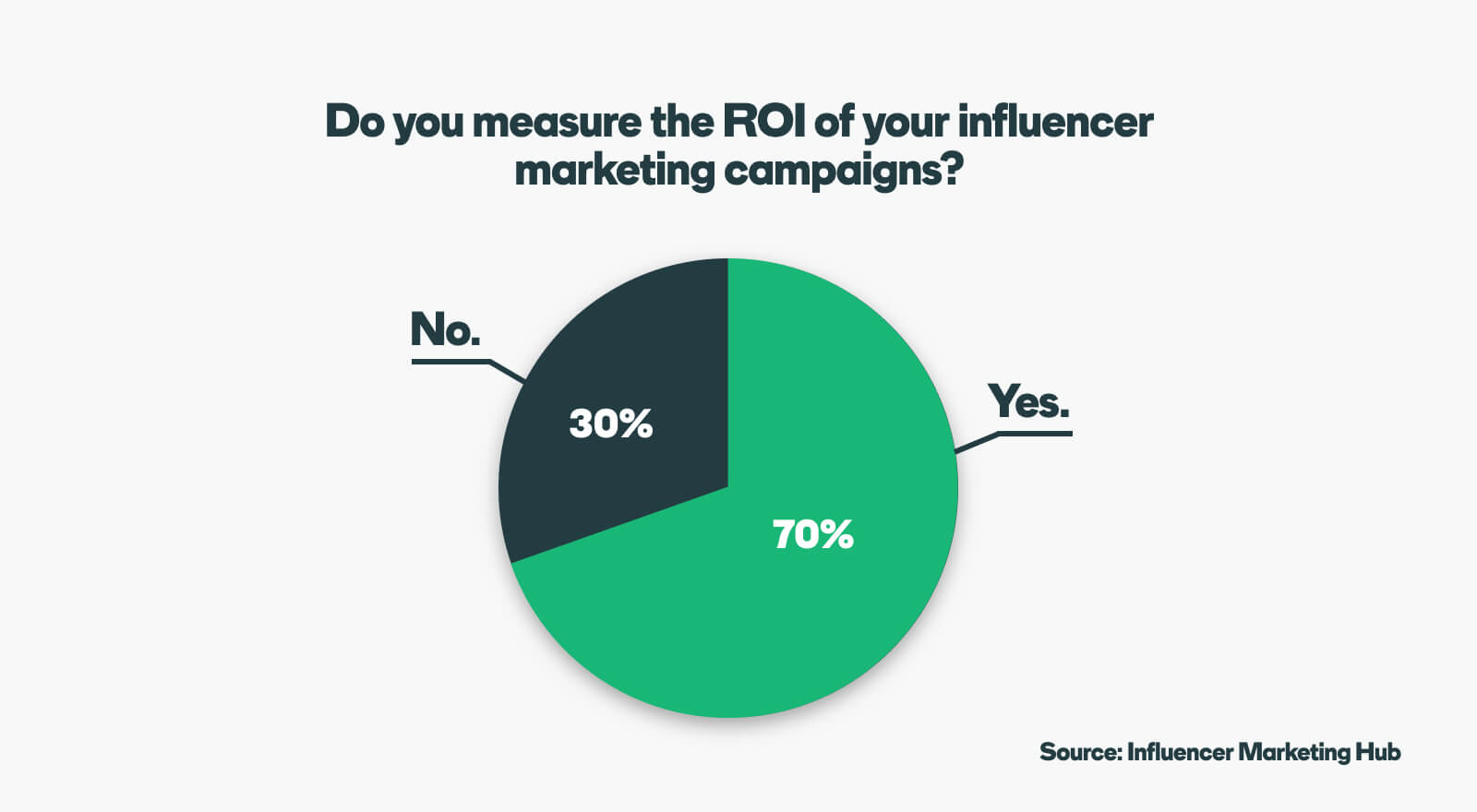
Whether you’re an influencer marketing pro or one of the 30% still not tracking ROI—here’s what you need to know to measure the success of your campaigns.
- What is influencer marketing ROI?
- How to calculate influencer marketing ROI
- Why measure influencer marketing ROI?
- What is the average ROI for influencer marketing?
- How to measure influencer marketing ROI
- Beyond ROI: Top metrics to track
- Tips to drive higher ROI from influencer marketing
- Ready to start driving more ROI with influencer marketing?
What is influencer marketing ROI?
Influencer marketing ROI (return on investment) measures the effectiveness and profitability of influencer marketing campaigns. It looks at the financial return a brand receives from its spending in influencer marketing.
How to calculate influencer marketing ROI
First, you need to figure out how much you invested and how much revenue your campaign generated. Once you have that information, it’s simple to calculate the ROI. The formula is: (Revenue/Cost) x 100.
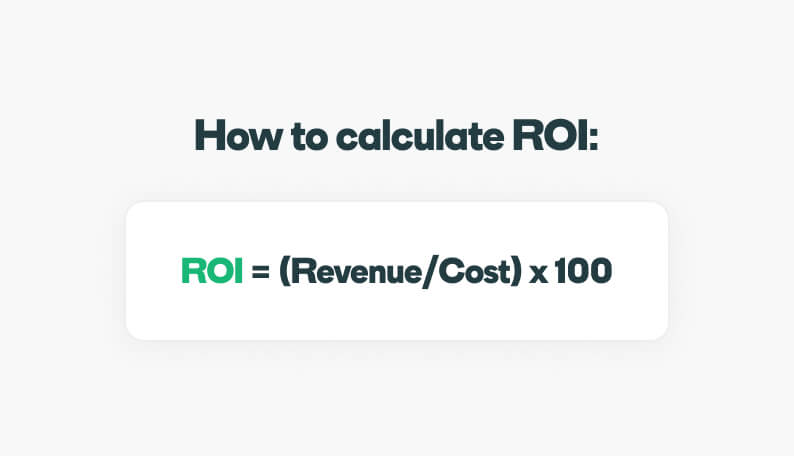
Example: If you paid the influencer $5000 which generated $10,000 in sales, then you are looking at an ROI of 2X or 200%.
Why measure influencer marketing ROI?
Influencer marketing is big business, with over half of brands spending more than $10k per year, and 11% spending over $500k. As with any investment, measuring your return is key. Otherwise, you won’t know if it’s worth it or not.
For most brands, return on investment is top of mind and 70% of brands measure the return on investment. However, 30% don’t. This is a missed opportunity because ROI is a hugely helpful metric.
Influencer marketing ROI can help you to:
- Figure out the total value influencer marketing drives for your brand
- Compare the performance of different influencers
- Decide which channels and formats to invest in
- And more
Overall, measuring ROI is essential if you want to get the most out of your influencer marketing and make strategic decisions based on data.
What is the average ROI for influencer marketing?
On average, brands make $5.78 for every $1 spent on influencer marketing. The top 13% of businesses drive $20 or more in revenue for every $1 spent.
Keep reading to find out how much your influencer marketing ROI is, and how to beat the average.
How to measure influencer marketing ROI
Influencer marketing doesn’t have to be a black box. There are many ways to track the return on investment of your influencer campaigns and activities. Here are a few of the most effective ways.
1. Affiliate links
By using unique affiliate links for each influencer, brands can track the traffic and sales generated by each influencer’s posts. This enables brands to attribute conversions and sales to each influencer and calculate the ROI.
2. UTMs
UTMs (Urchin Tracking Modules) are tags added to the end of URLs that allow brands to track the source and medium of traffic to their website. By adding UTMs to the influencer links in post, brands can track the traffic and conversions generated by that post.
3. Dedicated landing pages
By creating dedicated landing pages for each influencer, brands can track the traffic and conversions generated by each influencer’s posts. This allows brands to measure the ROI of their influencer marketing campaign and identify which influencers are most effective at driving conversions and sales. Dedicated landing pages also allow brands to tailor their messaging and offers to the specific audience of each influencer, increasing the chances of conversions and sales.
4. Unique discount codes
If you give each influencer a unique discount code to share with their audience, you can track the sales generated by their posts. This makes it easy to attribute conversions and sales to each influencer, identify which influencers generate the most sales, and measure the overall ROI of your campaign. Unique discount codes also incentivize followers to make a purchase, increasing the likelihood of conversions and sales.
5. Storyclash ROI Tracking
Storyclash is an influencer marketing platform that automatically tracks ROI for you and creates shareable reports.
Storyclash integrates with Shopify, the leading ecommerce platform, to track online sales. You just need to link Storyclash to your Shopify store, and it provides you with a report like this which shows you the ROI for each influencer:
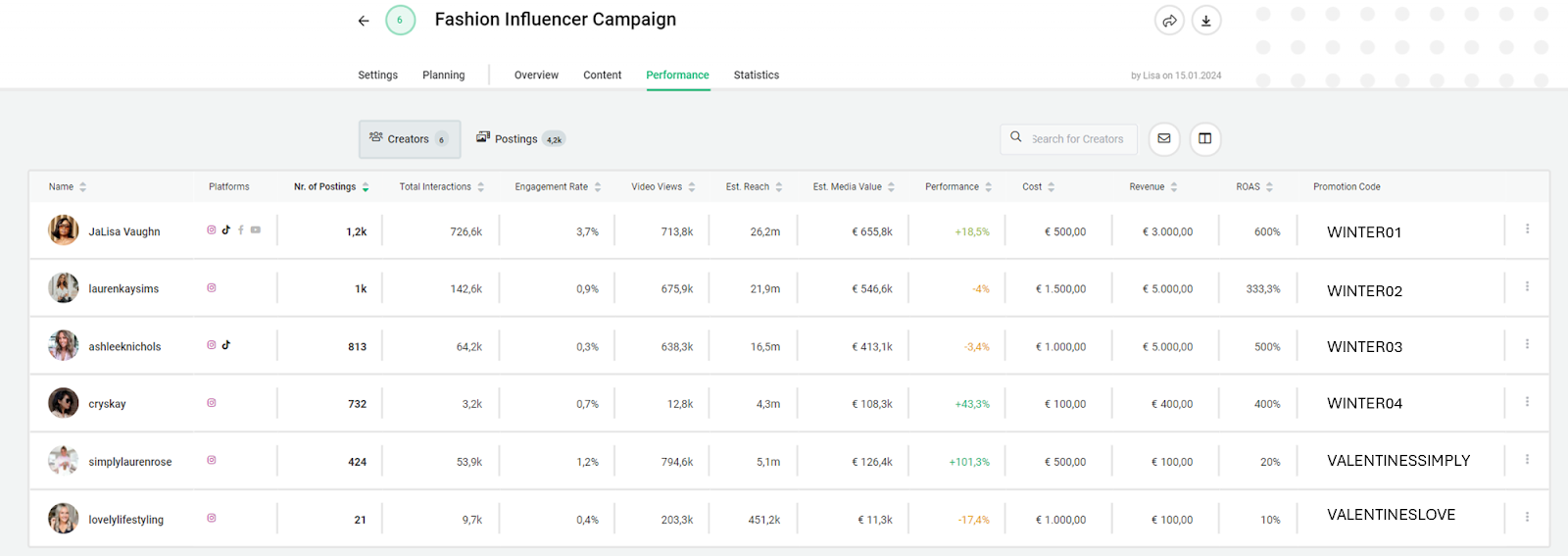
So, if your online store runs on Shopify, learn how you can use Storyclash’s integration with Shopify to automatically track your influencer marketing. Additionally, you can create and track Influencer utm links and analyze the performance of your campaign.
Beyond ROI: Top metrics to track
The metrics you choose to track will depend on your campaign goals. In recent years, brands have shifted their influencer marketing strategy from focusing on awareness to generating tangible business results.
There are many possible KPIs you can track, including:
- Impressions and views
- Engagement (like comments and shares)
- Sales (conversions)
- New customers acquired
- Earned media value
- ROAS (return on advertising spend)
Let’s take a look at Earned Media Value in more detail.
Earned Media Value
While ROI is one of the most important KPIs, it’s not the only one. The estimated media value helps marketers evaluate the success of their influencer collaborations and compare the media value with other marketing activities.
In fact, recent research shows that 80% of marketers use Earned Media Value to measure their influencer marketing campaigns.
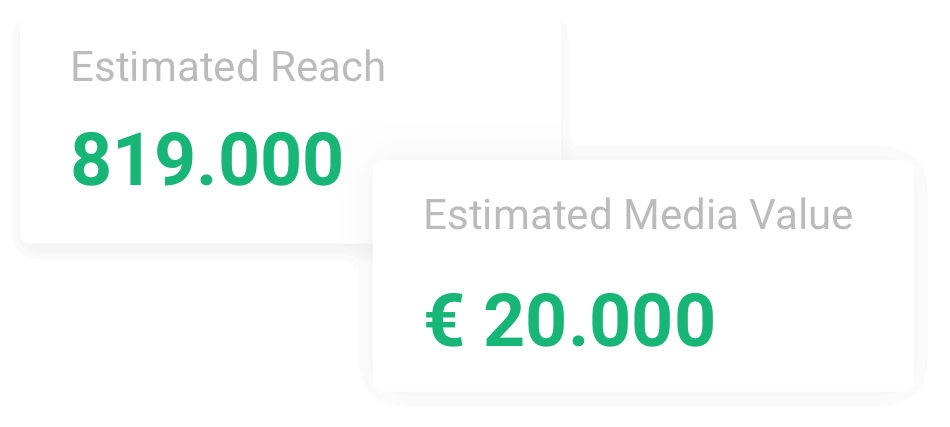
Check out the free influencer calculator template from Storyclash to predict and calculate the estimated media value of your campaigns. Our spreadsheet makes it easy to calculate the earned media value for any collaboration or campaign, tweet or Instagram story, Facebook post or YouTube video.
Tips to drive higher ROI from influencer marketing
Influencer marketing is more competitive than ever. More brands have realized the power of influencer marketing, which makes it harder to cut through the noise. Here are our top tips for running effective influencer campaigns that generate ROI.
1. Set clear goals
Be clear on what you expect to achieve with your influencer marketing initiatives. For DTC brands, influencer marketing is often their strongest sales channel, so you will clearly be aiming to increase online sales.
For consumer brands, the emphasis might be more on improving brand awareness and perception, ensuring your brand is top-of-mind among your target audience.
2. Be an early adopter
The early bird gets the worm – and that’s also true of social media. New trends, formats and platforms can offer an extremely high return on investment because the competition is not as established yet.
For example, brands who were quick to jump on TikTok reaped the benefits. Now, brands have the opportunity to explore new channels like Twitch. Check out our Guide to Twitch Influencer Marketing to explore the potential of this exciting new platform.
Embracing new channels before other brands establish a presence can be a good opportunity to get lots of user attention and drive a high ROI.
3. Reuse and repurpose your influencer content
Instead of relying on agency- or brand-created creative, try distributing high-performing influencer content across your paid and owned channels. Influencer content is already optimized for social, which makes it perfect for sharing across your own social accounts.
You can also share an influencer’s social media testimonial on your website, for example. Leveraging influencer content to build trust and credibility will save on costs of asset creation, thus increasing ROI.
Gina Tricot, a Swedish fashion brand, is doing exactly that. Read more about how they work their influencer marketing here.

4. Choose the right influencers
Influencers are make or break for your campaign. Look for creators whose audience aligns with your target customers and whose values reflect your brand. Don’t be swayed too much by vanity metrics, like follower count. Brand fit is more important.
Storyclash enables you to use AI to find the perfect influencers for your brand based on the content they create. Learn more about our unique approach to influencer discovery here.
5. Develop a long-term relationship with influencers
A long-term partnership is more impactful than one-off collabs. If an influencer mentions your brand several times in different posts and stories, their audience receives more exposure to your brand and the endorsement seems more credible. Foster mutually-beneficial relationships with your influencers and treat them like the value partners they are.
Ready to start driving more ROI with influencer marketing?
Measuring ROI is an essential part of successful influencer marketing. Now, you should have a good understanding of how to track the results of your influencer marketing campaigns.
Storyclash is the leading influencer marketing platform that helps top brands like Adidas and Audi to measure and maximize their ROI. Learn more about how we can help you find the right influencers and track your campaigns, or book a personalized demo to see what Storyclash can do.